Saturday, March 9, 2013

Hiking and Teaching


School thus far
Teaching my 8th grade math class.
Teaching is going really well so far for Lindsey and I. There are a handful of students that care a lot and try really hard, a handful that somewhat care and try sometimes, and about half that don’t care at all and don’t do anything. Maybe it is like that in all schools across the world? I don’t really know. We are trying to focus on the ones that care and care somewhat. 


Lindsey helping some students. Look how focused they look.....


They get so excited to be in pictures. They kept saying, "Sir, sir, take my picture." 

Me with our two Peace Corps supervisors. They came for a visit to check in on us.
Getting Around
I don’t know the exact percentage of people here that actually have cars, but according to Google it is less than 5%. In the villages (where we are), basically no one has cars. Therefore, getting around in Namibia is quite tricky. We have two options for getting around here. We can either 1.) Pay for a ride in these big vans that they call combis or 2.) Hitchhike 

This is what a combi looks like - a hippie van
Option 1 - When we go to Rundu to buy food, we pay for a combi ride. It is essentially a taxi service in a van, and that is how most Namibians get around. They like to cram anywhere from 10-20 people into ONE van, which pulls a trailer full of the groceries/supplies that people carry around when they travel. Being in a combi is not a fun experience. Imagine riding for 3 hours in a cramped van when it is 100 degrees outside and somehow - all of the flies in Namibia managed to get inside the van. And there is no A/C. AND the drivers like to blast Namibian music as loud as possible, which is a strange mixture of keyboard, electronic drums, and people yelling into a microphone with the Autotune on 100%. Does that sound fun? Nope, not for three hours at a time. Nevertheless, we try to avoid combi rides if it is possible. 

Option 2 - Hitchhiking- What? Are you guys crazy? No, not that crazy. It is also very common for people here to hitchhike. If you miss the combi or if you can’t afford it, this is your option. For Lindsey and I to hitchhike out of Mayara, we have to walk almost an hour to the one asphalt road going through the Kavango Region, and then wait by the side of the road until someone picks us up. That is why we don’t hitchhike out of Mayara because sometimes you can wait on the side of the road for hours because there are NO cars on the roads here. For example, over December, when we were traveling all over the place, we got dropped off in Keetmanshoop on the way to Luderitz (not like you know these places but just incase you wanted to look them up) and ended up waiting on the side of the road for 7 hours for a car, until we finally gave in to the scorching sun and paid for a combi.

However, hitchhiking is usually a much better option than taking a combi. Like in December, we hitchhiked from Rundu, all the way to Luderitz, and back up again - a distance over 1000 miles - for free (minus the one combi ride I mentioned earlier). We usually get picked up by white Afrikaners (those are the decedents of Germans still living in Namibia) who drive really nice cars, WITH A/C, and they never ask us for money. It is a much more comfortable ride, and completely free - usually. Of course, the Afrikaners don’t do that for everyone in Namibia. They only stop to pick us up because we are white and it is very unusual to see a white person on the side of the road. Needless to say, we have met a lot of interesting/cool people.

Rules of hitching
1.) You never, EVER ride in the back of a pickup truck. It is probably the scariest thing ever (have only done it once and it was our very first hitchhiking experience) and if you get in a wreck, hit a bump, blow a tire = death. So not worth it. Just wait for the next ride.

2.) Never ride in a Semi-truck unless it is the last resort . They go ridiculously slow and it will end up taking at least twice as long to get where you are trying to go.

3.) Negotiate price before getting in. As I said earlier, most of the time we get hikes from Afrikaners who don’t want money, but when we get hikes from anyone who is not an Afrikaner, it is best to talk about price before you get in. Otherwise, it will be awkward when you try to explain that you are a volunteer and are dedicating your life to the betterment of Namibia and you don’t have money because we are not paid (that is not true, we are just paid very little), but they don’t care because we are white and they assume we have lots and lots of money. If you talk about it first, they either say it is no problem or you can wait for the next car.

4.) Wear bright colors or your Peace Corps shirt. This obviously draws attention to you.

5.) Let Lindsey flag the cars down. Why? Sex appeal matters. Most of the drivers are men, and they are much more likely to stop for a helpless looking, white girl in a bright t-shirt on the side of a road than for a man. Lindsey and I almost always get picked up faster and get in better cars than most volunteers. Just sayin, Lindsey is a pro.

How could you not stop for this poor, helpless girl?


Bye bye kitty
So this past week one of our kittens died. I have never been a big softy for animals, but that was honestly one of the saddest things ever. We watched her slowly die over a period of 5 days and couldn’t do a single thing about it because there are no vets around here. We actually tried to bring her to a vet (we still have no idea what kind of vet or if he even could have helped) last Monday in a nearby village called Mukwe, but the vet wasn’t there and we were told he wouldn’t be back for several weeks. The next day, Lindsey brought the kitten in a box to Rundu, but the vet there said that she was already too far gone and he put her down. I don’t want to go on and on about a dead cat, but it was a very sad few days to say the least. I guess the only good thing about it is now we don’t have to buy as much cat food?
More questions? Send them over.

Peace,
Tim

Saturday, February 9, 2013

School has started!

School
Lindsey and I have FINALLY started teaching. I teach 7th and 8th grade math and computer class to 8th, 9th, and 10th grade. Lindsey teaches 7th and 8th grade English and art for 5th, 6th, and 7th grades.

Classrooms here are much different than the classrooms in America. We speak to them in English, but have to speak very loud and very slow, and can’t use ay contractions in our speech (like I just did when I said can’t) because they probably won't understand those. Most of them don’t understand English very well at all, so we repeat ourselves quite frequently. It is expected though, because 1. they are not used to our accent at all and 2. they are most likely only exposed to English at school when it is spoken by a teacher. We are trying to get them to practice speaking more so they gain more confidence in their ability.

We took pictures of all our students to learn their names. They don't like to smile in pictures here.


The good news is, there has already been a lot of improvement for me in math in just the last three weeks. I ask my classes so many questions and do so many examples every single day, that they have already started to get used to raising their hands and answering. Not a huge step, but at least it is a step in the right direction. I also give quizzes to them every Friday about what we have covered in the previous week, and today (I am writing this on Friday) I had a lot of the students get an A on the quiz in both 7th and 8th grade. Then again, there are a handful of students who missed every single question. That brings me to another point...

Namibia has one of the most peculiar rules in education I have ever heard of. The rule is, if you fail the same grade twice, you automatically get promoted to the next grade. Hence, there are students in 8th grade, ranging in ages from 14-22. Most of the older ones are students that have simply been passed on from grade to grade. If they fail one year, they know that whether they try as hard as they can and get an A, or if they do nothing at all and fail, it won’t matter because they still move on to the next grade. It completely kills the motivation for students who don’t do well. And it also explains how students can be 22 years old in 8th grade and be at a 3rd grade level. So for the students who don’t care at all about learning, it is like fighting an uphill battle that I’m sure teachers deal with all over the world. But I would imagine that the problem here is significantly worse than in any American school. How do you teach someone who simply doesn’t know how to learn? That is a question that I am sure most of us Peace Corps Volunteers up in the Kavango Region are pondering.

New pit latrine
The cats even struck a pose.
Construction began, and by that I mean a hole was dug in the ground, for our brand new pit latrine while we were traveling in December. It was actually finished two weeks ago. Look at it. Isn’t it a beauty? The fence of grass reeds are covered in gold and the concrete seat is sprinkled with diamonds. It is a toilet for royalty to say the least. It is connected to our homestead, so it certainly beats walking three minutes to the school’s pit latrine. The guy that made the seat out of cement and bricks made it a whopping 10 inches tall, so it is more like squatting than sitting. There is a song that was made by some other Peace Corps volunteers in another country called “poop in a hole” that you can watch here. I now feel like those words are relevant to our everyday life.

Athletic competition

Last Saturday, Mayara had an athletic competition amongst the students in the school. They were split up into 3 different teams - red, yellow, and blue.It was more or less a track and field meet with events such as 800m, 400m, 100m, long jump, and shot put (it took some serious convincing to get them to believe that it is called shot put and not short put). Lindsey helped with the yellow team, who ended up winning. - and I helped with the Blue team who came in second. Next weekend, the top finishers from Mayara will compete against the top finishers from 5 other schools in nearby villages - so that should be fun. Most of them don’t have running shoes, so they run barefoot or put layers of socks on to provide at least some level of comfort while running across sand, rocks, donkey poop, and broken beer bottles. Their feet are tough as nails though and dang... they sure can run.

Some of the girls doing laps around the soccer field.

The Namibian running gear. Bare feet, socks, and the occasional shoes


Birthday’s
A part of the culture here is, on your birthday, YOU are supposed to give other people gifts. Very cool, but quite the opposite from American culture I must say. For example, when it is your birthday, you are expected to provide a cake for your friends and buy them gifts - instead of them baking a cake for you and buying you gifts. This worked out to our advantage the other week when Lindsey baked our host mom a cake for her birthday and she bought us a bottle of wine. Apparently a common question to receive on your birthday is, “What are you going to give us for your birthday?” 

Lindsey and I have both had our birthdays in Namibia, but they were both before we actually came to Mayara. It will be interesting to see how our birthdays are celebrated this year.

The Heat
So in the last blog post, I said that it had been raining everyday and is much cooler outside than before December. Well I don’t know what has happened, but the past three weeks of this “rainy” season have been bone dry and stifling hot. No clouds, no wind, just sweat. Lots and lots of sweat. One of the other teachers told us that there is a correlation to rain and the phase of the moon. When the moon is more full, it doesn't rain, but when it is in a crescent it rains. And the moon has been out for a really long time it seems. However, they also believe (like legitimately believe) that all Americans belong to the illuminati and/or are spies, and that we are best friends with every celebrity. So it is hard to know what is mere speculation on things they believe are facts, or actual facts. 

What do YOU want to know?
So if you are reading this and are like, “Man, this Tim sure is a great writer and an intriguing person in general, but I really wish he would talk about ________.” , then you should either post a comment or send me an email at tim.habenicht@gmail.com and let me know what you want me to write about. So the content is in your control now!

Here are some pictures that were taken a while ago, but I thought you might all like to see them.

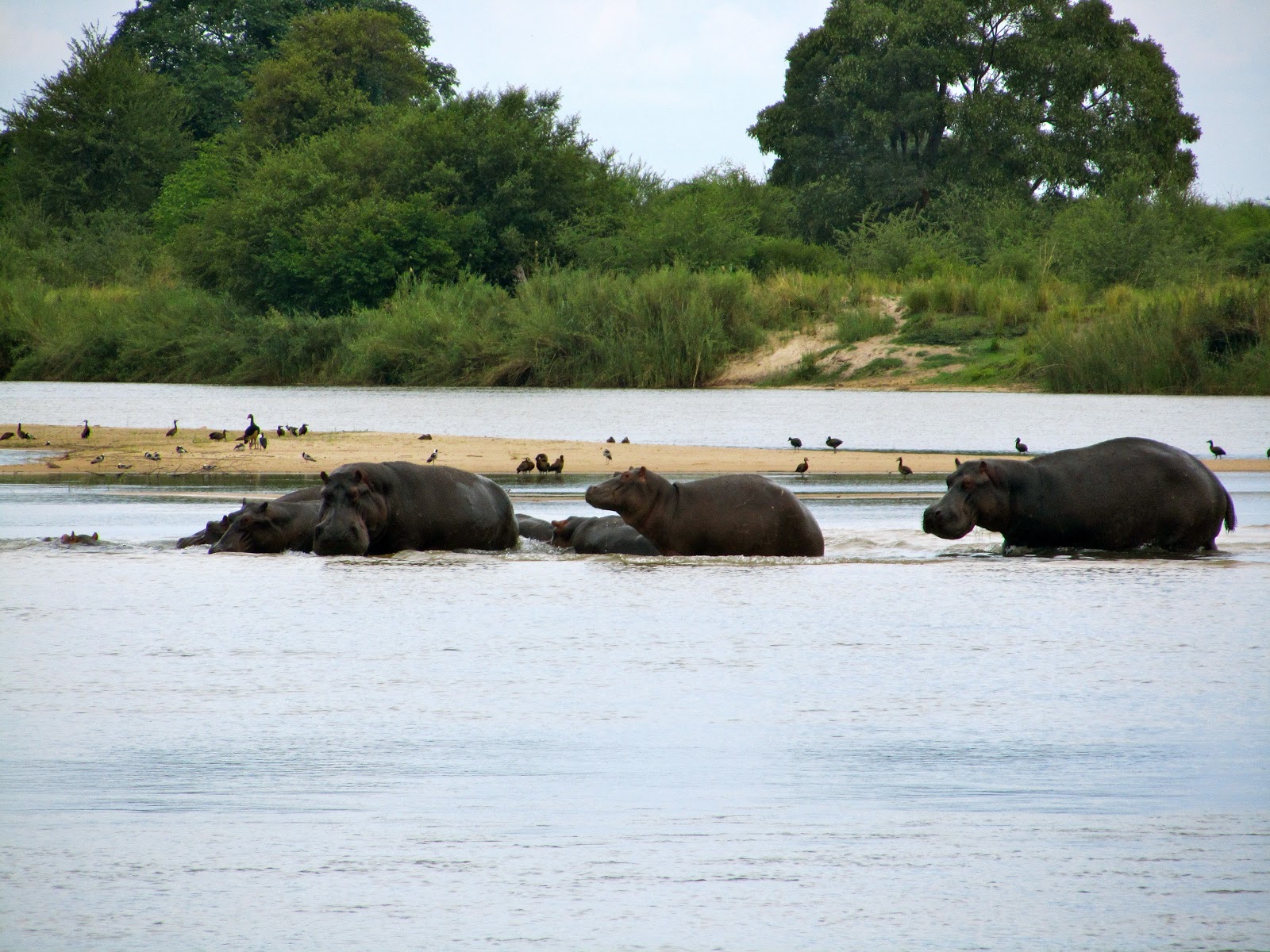
Some hippos in the Kavango River that we saw during Thanksgiving.

Taken right before we went skydiving in Swakopmund.

A brightly painted, classic German style building in Luderitz.

A famous church in Luderitz.

A famous building in Swakopmund.


Tuesday, January 8, 2013

December Travels


Reconnect
Our whole trip started with a week long Peace Corps required event called Reconnect. It was the first week of December and was held in a really nice lodge called Greiters (or something), up in the mountains outside of Windhoek. We had training sessions all day that recapped what we went over during PST and covered what we needed to prepare for when we actually start teaching. Lindsey and I were given the honeymoon suite, and we were the only room that had air conditioning, a california king bed, and a huge bathtub. It was nice.

Before we left Windhoek, we ate at this awesome restaurant called Joe’s Beer Garden. I ordered a sample platter of all these different meats which included ostrich, zebra, kudu, oryx, crocodile, and springbok. Oryx was the best meat I have ever had. I wasn’t a huge fan of the crocodile - it tasted like a “not so good” fish. All of the other meat was quite tasty as well.

Swakopmund
Swakopmund was AWESOME. 23 volunteers from our group went for a week and we all crammed into a 2 bedroom bungalow. Why would we do that? Good question. Needless to say, sleeping there wasn’t the most comfortable, but we really weren’t at the bungalow very much so it wasn’t too bad. Swakopmund is probably the most touristy city in all of Namibia, so there is a lot to do there. There are lots of restaurants and shops, and it is surprisingly clean.... so it was a nice change from the streets of Rundu. 

On the south end of the city, the sand dunes start. The first morning we were there, we went out and hiked around in the dunes. They seemed very impressive, until we saw the dunes of Sossusvlei. There was a group of 11 of us that went skydiving. I know I know, you are probably like - Tim, you went skydiving in Africa? Are you crazy? Well the short answer is - yes, I am. And it was definitely awesome. Lindsey sat this jump out, but after seeing the videos from some of the others that bought them, she says that she will go next time (Also, we both already went when we were 18). The instructor I jumped with had over 9,000 jumps, so I felt pretty safe with him. 

The dunes right outside the city.
The waves at Swakopmund were HUGE, and they crashed directly on the shore. The guys in our group went out to “play” in them everyday, only we came back beaten and out of breathe. 

Just having some fun.

Sossusvlei
Lindsey and I at the top of Bid Daddy - the tallest dune in the world
After Swakopmund, there were 10 of us that split the cost and rented two cars from Windhoek and drove to Sossusvlei. This was the best part of the whole month by far. I was one of the drivers of the two cars because it was a manual (I was one of the few that knew how to drive a stick) and it was certainly an interesting experience to drive on the left side of the road with the stick on my left. It was only tricky driving out of Windhoek because of the street lights, other cars, and an actual need to follow the law - but once we were outside of the city, we were on a dirt road for the next 7 hours with no other cars. We had two Polo Volkswagens, and I was pleasantly surprised at how well they held up on the trip over the tough conditions. We were on terribly rough roads, had to drive across several creeks, and drove up the side of a mountain on the steepest road I have ever seen (no joke, the tires actually started spinning on the asphalt road at one point so I had to roll back down to a flatter spot and try again with more speed). But, we made it through the whole trip without any damage to either car. 


A far off view of Big Daddy.

A lone Oryx that we saw on the walk to Big Daddy. Also, they taste delicious.


Lindsey and I making our way up.

This was the start of a place called Dead Vlei. It was amazing.


Anyway, Sossusvlei was one of the coolest places we have ever seen. It is home to the largest sand dunes in the world, and they have a deep red color. The park is full of ostriches, springbok, and oryx, and we saw a lot of them.  We went into the park twice, once in the afternoon and once in the morning. When we went in the afternoon, the sand was WAY too hot to climb any of the dunes- but of course, we did it anyway. When we went in the morning, four of us tackled the biggest dune in the world, called Big Daddy. It took us about 45 minutes of straight climbing (it felt like an endless amount of stairs) to do it and the view from the top was simply unbelievable. It literally felt like we were on another planet. There were giant red dunes as far as the eye could see on every side, and on the ground were scattered white patches of dried, cracked clay from where the water used to be hundreds of years ago. We ran and jumped down the steep side of the dune as fast as we could, and it took us about 3 minutes to get down.

Cheetahs 
A cheetah just chewin on a zebra leg.
So we didn’t actually stay in Sossusvlei. The ten of us camped outside in a town called Solitare. The campgrounds were really nice and there was a pool nearby where we went everyday to escape the heat. On the other side of the street from the campgrounds, there was a big cheetah conservation reserve. A few of us went on a two hour cheetah drive where we got up close and personal to several cheetahs. The cheetahs that the guide showed us are ones that can never be released back into the wild. Most of them were rescued by this organization from farmers. Are you ready for some fun facts? Farmers will often shoot cheetahs for killing their livestock (they see them as pests), but if they find cubs after they have killed the mother, sometimes they will call a conservation organization to come rescue the cubs. These cubs grow up without learning how to hunt or fend for themselves in the wild, since they don’t have their mother to show them, so the cheetah conservation fund keeps these cubs permanently to be “show” cats. They still run around wild on a 500 acre plot of land, but they are tame enough to walk right up next to and take a picture with (only after they have been fed).


Sometimes, farmers will call the organization to come pick up a cheetah before they shoot them. Those cheetahs are then caught and relocated back into the wild in a safe area, away from farmers. However, cheetahs are actually big softies and are very prone to stress (like the stress from moving to a new location). So if you simply caught a cheetah and released it somewhere else the next day, it would die in a matter of weeks because it completely stops eating from the stress. Weird right? We were told that with lions and leopards, you can release them anywhere the next day and it doesn’t even phase them - not cheetahs though. So this cheetah conservation organization helps gradually release cheetahs back into the wild over a period of 6 months to save them from the stress. No tourists are allowed to see the cheetahs that will one day be released. Another fun fact - Namibia has more cheetahs than anywhere in the world. This is because farmers essentially wiped out all of the lions in the southern part of country, which has allowed cheetahs to flourish because lions were one of their biggest predators. 

Luderitz
We stayed in Luderitz for 10 days, the longest of all of our stays. Luderitiz is a very small German town on the coast and it took FOREVER to get there because it is so isolated from everything. On one side of Luderitiz is the barren Namib desert that streches for hundreds of miles, and on the other is the chilly South Atlantic coast. Although Luderitz is also a German coastal town like Swakopmund, it felt nothing like it. There are almost no tourists in Luderitz, and the town is relatively run down. It is still cleaner than most of the cities in Namibia, but most of the awesome German style buildings are in need of some serious renovation. It certainly had a unique, but very cool feel to it. There were 18 of us in Luderitz for Christmas and New Years Eve, and we stayed with the two volunteers from our group that are posted there. We had a blast.

Luderitz is the windiest place I have ever been - like the wind is so strong that it literally knocks you over. And you are constantly being pelted by flying sand. We went swimming (only for a few minutes) everyday in the freezing water on an island called Shark Island. You should look up and read the history of Shark Island. In a nut shell, it was the site of the first German concentration camp, which was a prequel to the concentration camps used during WWII. When the Germans where mining the area, they used to put the Namibian workers out on this island (because they didn’t need to watch them out there since the Namibians couldn’t swim), and when the workers would die because of the terrible conditions, their bodies would be thrown out to the sea and eventually eaten by sharks - hence the name, Shark Island. Now the island is connected to the shore by a road and is a campground for travelers. It is a beautiful island with a very sad history.

We went on a boat cruise in the coves surrounding Luderitz where we saw dolphins, seals, penguins and flamingos. I never expected to see penguins in Namibia. 


We also visited an old diamond mine ghost town, which at one point produced 20% of the world’s diamonds. Apparently there used to be so many diamonds in the sands surrounding Luderitz, you could just reach down and pick up a handful of sand and find diamonds. I tried it a few times but never found any..... maybe next time.

An old house that is slowly being overtaken by the dunes.

Oh hey bathtub in sand.
What comes next?
Even though we have been in Namibia for 5 and a half months, we haven’t even started our actual job yet - the whole reason that we are here. School begins on January 15th, so that is when the teaching fun will begin. I just found out that only ONE 10th grader passed this last term (remember passing is only 30%), so hopefully this year they will have more - I guess time will tell right?

Rainy season is definitely upon us. We have only been back for 3 days, but it has been raining on and off the entire time. After being gone for almost 40 days, when we got back to Mayara our yard looked like a jungle of weeds and tall grass. It is crazy how green everything is right now. 

Until next time.
-Tim

Friday, November 16, 2012

Cobras and Christmas


Mozambique Spitting Cobra
Our pet cobra.

Let me tell you a little story...... I woke up on a Sunday morning (four Sundays ago to be exact) and stood up to put my sandals on in our sleeping hut. I felt some liquid drip on my neck and I looked up because I thought maybe our thatch roof was leaking. I didn’t see any water dripping down and it looked like it was sunny outside, so I ignored it and went back to putting on my sandals. Then I felt the drips hit the back of my neck again, but this time I heard a faint “hissss” as well. I turned to look behind me and saw a cobra with his mouth wide open about a foot away from my head, hanging just above the door. I literally jumped across the bed to the other side of the hut and Lindsey and I sat there for about 20 minutes in the opposite corner, hoping that the he would eventually crawl out. He didn’t. He sat there, just hanging above the door staring at us with his neck flared out. Eventually, I put our blanket over my head like a cape for protection (cause honestly, I didn’t know if he was going to like let go of the grass and drop down on me or something) and took one step and did a supermanish jump out of the door, followed of course by a graceful face plant in the sand outside. I ran over to some of the other teachers’ houses who are apparently “experienced” snake killers and they came over with some sticks to kill the snake. Lindsey then jumped out of the hut as well, and we knocked the snake from our roof down to the ground - where he was sentenced to death by sticks.

It turned out to be a Mozambique Spitting Cobra, which according to Google is the second most dangerous (not deadly) snake in Africa behind the Black Mamba. The Peace Corps gave us a snake book about all of the common snakes in Namibia with pictures and everything, so it was easy to find out what kind of snake it was because not that many cobras actually spit. It didn’t really scare me much at the time, but the more I thought about it, the more freaked out I became. The snake easily could have bit my neck or spit in my eyes possibly causing blindness. It was a Sunday morning so the one health clinic in town was closed, so it would have been hours until I got help. I’m telling you, God was watching out for me - cause that could have been really really bad!

I have my trusty axe handle, ready to smack him when he falls
Meet Shiner and Tafel - our two new kittens
To counter the snakes, we got two kittens. The week before the snake came into our hut, an entire mouse family moved into the mud walls of our sleeping hut. I didn’t really care about it that much, besides the fact that they kept kicking dirt out onto our floor from within their holes. It was more of a minor nuisance.  However, snakes eat mice so that could have been one of the main reasons why the snake was in our hut in the first place. If we kill the mice, which I have killed all 7 of the ones that were in our hut with a mouse trap, then hopefully the snakes won’t come. So the kittens will keep the mice at bay once they are full grown which will deter the snakes, but we were also told that snakes won’t even come near cats because cats also kill snakes - so hopefully that is true. Another one of the teachers also gave us an old car tire, and said that snakes hate the smell of burning rubber. He said to burn some of it once a week and it will keep the snakes away. Can anyone verify if that is actually true or just an old wives tale? 

School so far
Since Lindsey and I don’t actually start teaching until the start of the next semester in January, the school day has been going by pretty slow for us since we don’t have much to do yet - which is from 7:30 AM - 1:20 PM. The Peace Corps wants us to use this time to observe the Namibian school system and how teachers run their classes in Namibia. It is a fantastic idea, but unfortunately there is not much for us to “observe.” The students are studying to take their final exams (which are countrywide examinations made by the Ministry of Education), so they have been spending the majority of the day at school reviewing notes and whatnot. Hence, there is not a lot of teaching going on at the moment, so we still don't have a very clear idea of how the school actually functions.

Interesting statistics - Every year, Namibia releases a form that has each school ranked by the performance of the 10th graders according the region they are in. Mayara Combined School (our school) was dead last in the Kavango Region. And the Kavango Region is the worst performing region in Namibia, so that means that Mayara is literally the worst performing school in all of Namibia. Lets see what those statistics say once Lindsey and I are done with them!!

Meeting the Peace Corps Africa Director
All of us with the Peace Corps Directors

We finally saw some hippos chilling in the river outside the lodge where we ate. 
Last Wednesday, Lindsey and I met up with four other PCVs in the same general area of the Kavango Region that we are, and we all met with the Namibia Country Director, Gilbert Collins, and the Africa Regional Director, Dick Day, for lunch at a lodge along the Kavango River. It was pretty cool to meet the man that is in charge of ALL of Africa for the Peace Corps. We all talked for a few hours and got a free lunch out of it so it was definitely worth it. They also offered us a ride back to our respective villages so we did not have to hitchhike, so the Country Director and the Africa Director have both been inside our hut. They were also very interested in the snake story haha 

Thanksgiving and Christmas
For Thanksgiving, all of the volunteers in the Kavango Region (I think there are 35 of us) are meeting up next weekend at Popa Falls, a very nice area along the Kavango River just outside of Divundu. There will be food, drinks, and good ole American fellowship. What more could you ask for on Thanksgiving? We are also going on a river cruise and another safari at Mahango Game Park for half price - because one of the volunteers is stationed right next to the park and is friends with the owners. It should be a good time.
I am not sure if I will be able to post another entry for the next two months so I might as well tell you all now. The first week in December, all of the volunteers in our groups (Group 36) are meeting for “Reconnect”  in Windhoek with the Peace Corps staff for a week of training sessions and whatnot. I imagine it will be very similar to the training we had the first two months we were in country.

After Reconnect, our entire group is going to Swakopmund for a week. Swakopmund is a coastal town that has a huge German influence and apparently some massive sand dunes (Namibia has the biggest sand dunes in the world). We will stay in beach bungalows for the week, at a cost of $7.50 USD a night I might add, and then a few of us are going to Sossusvlei - the most photographed area in all of Namibia. It is in the Namib Desert, and I have heard it is amazing with giant red sand dunes everywhere. We will camp there for a week, and then go to another costal town called Luderitz for Christmas and New Years. There are two other volunteers from our group actually stationed in Luderitz so we will be staying with them for free! After Luderitz, we are staying the next week with another volunteer in a town called Aroab, where we will probably visit Fish River Canyon (the second largest canyon in the world behind The Grand Canyon) and maybe a game park in South Africa. We will return back to Mayara the first or second week of January to get ready for school which starts back up on January 14th. Needless to say, there is a LOT of traveling coming up for Lindsey and I in December and it is going to be awesome. If you do not hear from us through the blog until January, it is because we are either rolling down sand dunes or sucking down some dark German Lager on the beach.  Until we meet again.....

Side note
I also joined the Mayara men’s soccer team, so for the past two weeks I have been playing soccer for 2 hours a day on the fields outside the school. The majority of the players are in their 20’s - and also in 8th grade. Interesting.

I am also 25,000 words into a novel that I started 2 weeks ago. There was a challenge among volunteers to try to write a 50,000 word novel in November, and since I had more than enough free time, I joined in. And don’t ask, I will probably never let you read it :)

-Tim

Saturday, October 27, 2012

Our first two weeks in Mayara


Mahango Game Park - The pictures you have all been waiting for!

Lindsey and I are really lucky. There are plenty of volunteers that have been here for over a year, that have still not seen a single “exotic” wild animal. Lindsey and I got to go on a safari our FIRST weekend at site in Mayara. It is about 30 minutes away from us and only $10 Nam dollars to get in if you have your own car! Another teacher has a car and offered to take Lindsey and I if we paid for gas - not a bad deal at all. So all in all, it cost the equivalent of $34 US dollars for both Lindsey and I to go on a safari. We saw zebras, giraffes, hippos, elephants, water buffalo, lots of springboks and other crazy antelope looking things, and a male LION - which apparently is very, very rare because lions stay far away from humans. For example, the teacher that drove us has been on many safaris and has lived in Namibia his whole life, but has only seen one other lion - ever. Apparently we are good luck! So if you have your own car and are allowed to drive in a game park (which I think most of the game parks in Namibia offer that), you are free to drive along all of the dirt paths and stay in the park for as long as you want. We were only there for a little over two hours, so I am excited to go on another and bring some food and drinks and just chill in the car with the windows down, just watching all of the animals for the entire day. In Mahango you are allowed to get out of your car, which we did a few times, but our teacher friend told us to always leave the car doors open incase you have to make a mad dash away from an animal. Not bad advice.

A lot of people have been asking if we have seen any wildlife actually in Mayara. The answer is unfortunately no and here is why - animals stay away from humans. We are the most dangerous predators on the planet and the animals know to stay away from us. We see animals sometimes off to the side of the road when we are driving, but they are not around villages. Most of the wild animals are in game reserves where they are protected. However, there are crocodiles and hippos in the Kavango River, but we have yet to see any..... maybe during rainy season?

This is the first thing we saw when we pulled into the park!

A male lion munching on a zebra.


Hut Life
Our sleeping hut
We are finally in our permanent housing! After 2 months of training in Okahandja, and 2 weeks of waiting in Rundu, we are finally here. We have two huts on our homestead - a cooking hut and a sleeping hut. The cooking hut is where we hang out most of the time because the sleeping hut is so small that the bed takes up nearly the entire thing! They gave us a thatch roof on the sleeping hut which keeps it significantly cooler. Our kitchen hut has a tin roof and is like a dang oven in the middle of the day! Both huts have electricity (a very long extension cord is running from the nearest school building to our hut) but we do not have running water, so I have to fetch water every other day. And let me tell you, fetching water is no easy task. We have three big 25 liter jugs that weigh about 65 pounds each when they are full, and it is probably about 300 yards from the bore hole to our hut. That is a long way to carry two full jugs at a time! The funny thing is, they didn’t install the bore hole until about a year ago, so anytime before that everyone had to fetch water from the river - which is about a 25 minute walk from our hut. Now that would have been a workout......
Our kitchen hut. Lindsey is cutting up some vegetables to cook on the fire
Have you ever wondered how they make a mud hut? Well, let me tell you.... They cut down trees to use as the supports for the walls all around the hut, and then use smaller branches and bind them horizontally all across the frame. They then find an old termite mound (they are everywhere and also huge ha) and mix water in with the dirt, until it turns into a sloppy, muddy goop. Next, they pack the mud in between the tree branches and sticks, and smooth it out on the inside to make the walls look nice. The mud dries as hard as cement, so it is not like what you typically think of as “mud”. It is not just mud - oh no, it is termite mud! We have cement floors in both huts which is nice, because most huts have the termite mud for the floor as well. 

That is 65 pounds of water on her head.... how do they do it!?
We have a little bathing area outside our kitchen hut that they tell us will eventually have  grass reeds around it so no one can see in during the day. However, the fence is not up yet so we have been bathing outside at nighttime so no one can see. Exciting right!? No, not really. They are also going to dig us a pit latrine nearby our huts, so we don’t have to walk so far to go to the bathroom. Our school has a pit latrine (which is basically a nice version of an outhouse), and it is about a 2 minute walk away.... so it is a little less than convenient, especially if one of us was to get sick. But hopefully they will actually dig our pit latrine soon!

We have had several kids that like to come up and stand at the fence in the entrance to our homestead, and just.... watch us.... like zoo animals ha. We are some of the only white people they have ever seen, and certainly the first white people to ever live in Mayara, so it is like they don’t even know how to act around us - so they resolve to just staring. Once we actually start teaching in January I think they will open up to us a lot more. 
There are 7 different buildings like the one shown on the left. 
Mayara Combined School
Mayara Combined School has about 480 students in 1st through 10th grade. The students are excited that we are here but are still very timid and laugh when we speak to them. Their culture here is very different from our own. They have a huge respect for authority, so the kids are often so shy they do not even look at you or speak when you ask them a question. This is probably amplified tremendously with Lindsey and I because they are already so timid around elders, we are white, and they are not even remotely confident in their English - especially when speaking to native English speakers. Hopefully they will feel more confident in English by the time we leave! Also for clarification, we found out that a lot of you were under the assumption that we are teaching with all of the other Peace Corps volunteers in the same school - that is not the case. All of the volunteers are spread out all over Namibia at separate sites. Lindsey and I are actually the ONLY volunteers in Namibia that are teaching at the same school. So Mayara Combined School is the only school that has two volunteers. The few other married couples live in the same place, but teach at separate schools. Lindsey and I are the exception I guess ha

Anyway, in Mayara classes are taught in their native language, Thimbukushu, until they are in 5th grade and then it switches to English. All classes throughout Namibia are taught in English after 5th grade. The biggest problem is, no one here is that good at English. A national language test was conducted among all of the teachers in Namibia, and there were only three teachers that passed as proficient in English. Three. And they were all foreigners from Europe! So teachers are teaching in a language that they are not comfortable with or fluent in (this is a general comment of course- there are certainly teachers at our school who speak English very well), to students who do not understand what they are saying. Needless to say, it is obvious to us why the Peace Corps was asked to come to Namibia - to help with the English! Hopefully Lindsey and I will be able to get their proficiency up!


EAP
We had only been at site for five days and the electricity went out in the whole Kavango Region. The final report was that a big group of guys wanted to steal the bolts out of the main electric transmission lines that supply power to the region, and when they took the bolts out a whole bunch of lines fell down at the same time in a bad storm. Since our power was out for a few days, a lot of the food we had just bought went bad, which was a huge bummer, and we had no cell phone coverage - so we were off the grid from everyone. We cooked on an open fire and ate by candle light for a few days so it was like we were camping for real! Then all of the sudden one afternoon, a caravan of other PCVs showed up with some PC staff members and we were told that all of the Kavango PCVs were being evacuated to Rundu until the power came back on for safety reasons. The power being out didn’t really effect Lindsey and I that much, but it could have turned into a very big deal if it didn’t come back on soon. Many of the villages and cities didn’t have electricity, running water, food, or cell phone coverage, so some of the volunteers at those sites went a few days with little to no food or water, and they couldn’t even tell anyone they were in trouble. Hence, it was a very bad situation for some volunteers, and we were all evacuated to make sure everyone was safe and sound. So we just spent a few days at a secluded campsite on the Kavango River just outside of Rundu, where they had food and water brought in from Windhoek for us. The campsite also had a power generator so we were able to live relatively normal lives for those few days. It actually ended up being pretty fun and we got to meet all of the other volunteers in the region.

Peace,
Tim